April 27, 2012

If you happen to see someone with two pairs of binos...

A recent post about intoxicated birding on the renowned 10,000 Birds blog has had me laughing since it was posted.  While I'm sure we're all guilty of BWD (Birding While Driving), I bet there are just as many of us that can admit to birding with a buzz-on.  Just as long as we don't combine the two, then I think we're okay.

In 'spirit' of the topic, I remembered these babies sitting on my shelf and they are just too hilarious not to share...


Based on the photos on the back of the box, I think they are intended for sporting events...


These are serious booze vessels we're talking about here, not one but TWO, separate eight-ounce flasks cleverly disguised as old-school optics...


They thought of everything - carrying strap, funnel, labeled "power"...


I'm not sure who could consume 16 oz. of liquor and still get a good ID on a bird, but maybe they're made to pass around?


Unless I see someone staggering around while birding I don't think there would be anything suspicious about carrying two pairs of binoculars...


I've never actually used them, but all I know is that when I saw them, I had to have them.  Now I must add - please drink and bird responsibly!

April 22, 2012

Iroquois and Montezuma NWR's...

I swung through the Iroquois and Montezuma NWR's again on my latest foray to conduct Northern Harrier and Short-eared Owl surveys in NY.  While both visits fell during a poor time of day, there were still some feathered friends kind enough to allow for viewing pleasure.  It was still very much spring and not yet summer, but the Tree Swallows were out and about, looking perfectly coiffed in all their sapphire glory...


This little guy obviously meant business and was likely to pull a Monty Python's Holy Grail-style rabbit-attack if anyone dared to not obey the sign...


Though my digi-scoping skills clearly have gone to rust, I was very excited to see my only-second-ever Caspian Tern on it's migratory pit-stop at Iroquois.  I think it may have been asking that American Wigeon for directions...


Since my last visit, Iroquois staff have been busy setting up nesting tubes for the ducks...


And the fowl, in turn, have been busy occupying them...


I finally got a photo of a militant Red-winged Blackbird (RWBL).  The word for that red-shoulder - 'epaulet', must be related somehow to the term for military uniform shoulder boards - 'epaulette', which is french for "little shoulder"...how perfect.  But I prefer to think that the RWBL's came first - inspiring military, runway, and rock-star fashions alike...


I saw more American Coots than I've ever seen in Maine and was delighted to actually hear them as well.  They made a sound I can only liken to a squeaky bicycle horn crossed with a kazoo...


Then at Montezuma there were these distant swans adorned with sassy green wing tags.  I think they were Tundras, but admit I was too hurried to bust out my scope and window mount.  The tractor trailer trucks on I-90 made for such a lovely background...


American Kestrels were seemingly everywhere and Turkey Vultures kept materializing out of nowhere...


Scoobs eventually tired of all the roadside birding, signaling it was time to head out...


Overall it was fun, fun, fun - and I look forward to once again stopping by these magnificent examples of habitat conservation and management during my next trip to NY.
  

April 2, 2012

Batty About Bats...

Over the years I have been fortunate enough to work with some really cool people studying bats.  Bats are often poorly understood by the general public and unfortunately have an undeserved reputation as being creepy.  This misconception could not be further from the truth!  In reality, they are gentle creatures who care for their young and eat more insects than you could even imagine.  They are really quite beautiful when viewed up close - a perfect example is this Eastern Red Bat (Lasiurus borealis)...


Bats are in the order Chiroptera which means "hand wing" or "winged hand" aptly named because those bones in their wings are actually their fingers.  Bats are the only mammal capable of powered flight (versus gliding like my Glaucomys pals).  And even more awesome - their knees bend backward making them capable of catching insects with their webbed tails and of doing things like this...


Sadly, many bat species are in serious decline and scientists are working hard to understand and combat a fairly recent discovery of a bat illness called white-nose syndrome (WNS) that has been decimating bat populations across the eastern United States.  WNS gets it's name from a fungus called Geomyces destructans that often grows in little tufts on bat noses.  WNS basically causes bats to use up their winter fat reserves earlier than usual.  Many of the afflicted bats emerge from their hibernacula too soon - only to find the world still in the depths of winter.  With nothing to eat, the bats freeze and/or starve to death.  In the five years since the discovery of WNS in New York, over 5.7 million bats have died and WNS has been confirmed in 18 states and also in Canada. Terrible you say?  How can I help you say?  There exists a wonderful group of bat conservationists called Bat Conservation International (BCI) and if you're looking for a good cause to donate to, this is it!  When you become a member of BCI you know you're helping bats all over the world AND helping scientists battle WNS here in the States.  

Back in the days before WNS, capturing and handling bats was a much simpler task where a new pair of surgical gloves for every bat and strict decontamination protocols were still a thing of the future.  In these pre-WNS photos of a federally endangered Indiana Bat (Myotis sodalis) you can see the arm band and the antenna of the temporary radio transmitter that we used to track his movements...


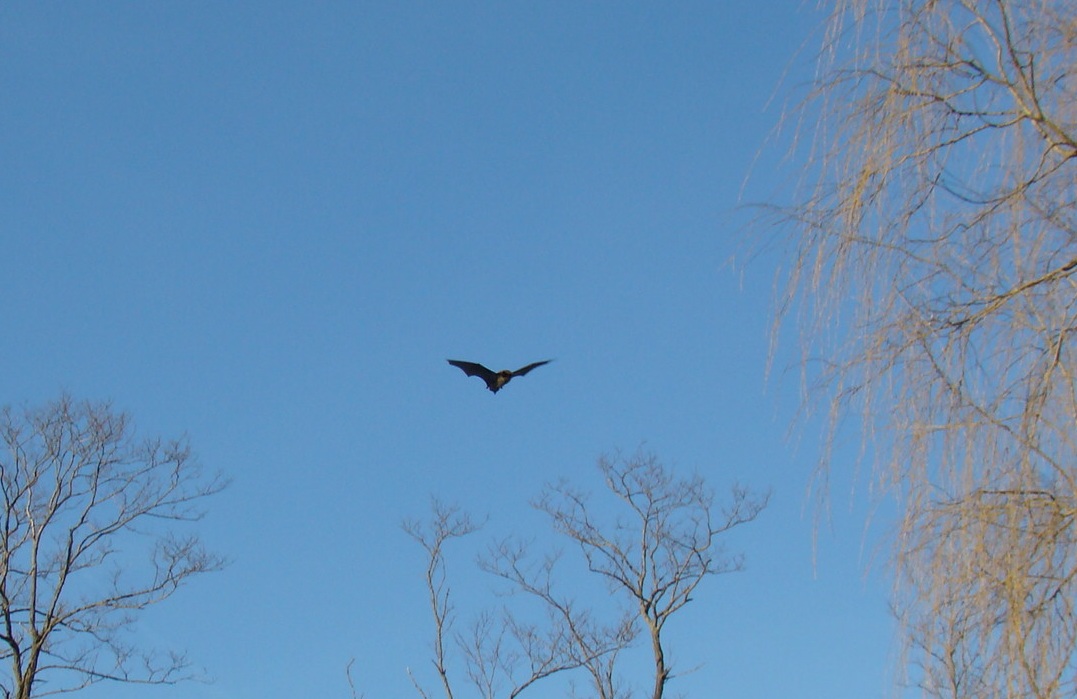
I've noticed fewer and fewer bats in my yard over the last few summers.  This year on St. Patrick's Day I had a bat foraging in my yard during broad daylight.  My theory is that it was too cold at night for bugs but warm enough during the day for hatches of flying insects.  This little guy must have been pretty hungry and opportunistic to be out and about...


After consulting with some of those aforementioned pretty cool people, it is likely that this St. Paddy Bat was a Northern Myotis (Myotis septentrionalis).  I felt pretty lucky to even have a possible myotis species in my yard as members of this genus have been hit pretty hard by WNS.


While there is absolutely no reason to be freaked out by bats, there is reason to be freaked out by the recent decimation of once healthy bat populations.  It is quite possible species that were fairly common in the not-so-distant past will someday be listed as endangered.  I really hope the situation doesn't come to that and maybe the bat house I put up last year will one day even have residents...

   
Hopefully the battle against WNS will someday be won and the future for bats will be better.  Our world would certainly not be the same without them. 

March 13, 2012

Florida Lake...

A year ago this week I was in Florida on avication, exploring hundreds of thousands of acres of protected lands looking for birds.  Sigh.  Unfortunately, due to budgetary constraints, there will be no such extravagance this year.  Instead, I am determined to enjoy my local surroundings and avifauna all the more.  And though I may not be able to go to Florida this year, I can go down to Florida Lake anytime.  I am fortunate enough to live less than a half mile from this gem...


It's still mostly ice-covered now, but soon there will be American Bitterns 'gump-de-gumping' from it's edges, thousands of swallows skimming it's surface, and Wood Ducks nesting in it's tree cavities and nest boxes...


The lake was named 'Florida' because it's shape resembled the Sunshine State.  It is indeed a shining local example of land reclamation and conservation.  Some brilliant folks had the foresight to acquire multiple land parcels surrounding the lake and turn the whole area into public open space.  Approximately 167 acres were put into conservation with help from local land trusts, the Land for Maine's Future program, and a U.S. Fish and Wildlife Service  grant through the North American Wetlands Conservation Act.  The area is designated by the state of Maine as High Value Wading Bird and Waterfowl Habitat and provides some of the best (and only) habitat of it's kind in the whole area.  There is now a great network of trails and more than 100 bird species have been documented on the property.  Thanks to all these conservation efforts, this is the only type of MALL that can be seen from here...


Historical beaver activity contributed to the great wetland habitats found at Florida Lake today.  As a result, there are some really good spots for birds like these Hooded Mergansers to hang out...


Apparently beavers are still hard at work creating and maintaining wildlife habitat in the area...


Not only do I love Florida Lake but I also happen to have a dream for it.  There exists yet another adjacent land parcel that in my opinion also needs to be acquired.  This would expand the Florida Lake area by about 30 acres.  Unfortunately, this parcel has quite literally been trashed and would need some major clean-up and costly restoration efforts...


I have a vision of beavers returning to this place and creating more and more high value habitat.  This vision includes the Least Bittern, Great Blue and Green Herons I've seen out there being able to forage in cleaner water, the breeding woodcocks and saw-whet owls not having to work around piles of trash, and hearing more than just one Whip-poor-will out there in three years.  This vision includes opening up more acreage for people and wildlife to peruse and enjoy.  Even though we're on the non-oceanfront side of L.L. Bean, I believe if we continue to rebuild it, they will come. 

Can we really put a price tag on the value of conservation lands?  To me they are priceless and worth the costs and efforts to protect.  For my dream to become a reality, a rigorous grant proposal will need to be written, matching funds will need to be secured, an ambitious restoration strategy created, and the right people convinced that taking this project on will be worthwhile for the town and it's residents.  Act locally, right?!   

I'll be needing all the luck I can get on this daunting journey of getting this parcel picked up and protected.  It will certainly be a challenging endeavor...but SO worth it!

March 9, 2012

NY Wanderings...

A recent trip to upstate NY produced some good early spring bird sightings.  The state fortunately has some sweet National Wildlife Refuges (NWR) that I have been meaning to stop at for ages and finally did.  I like to think my tax dollars go to support places like this...


I was really excited to see some guys that I haven't seen recently like HUGE flocks of Snow Geese...


And what appeared to be a billion Canada Geese chillin' on the ice with over 200 Tundra Swans...


As goes the sometimes dismal luck of a birder, Montezuma NWR was closed to humans.  I wish ALL of my taxes could go to NWR's so that they don't have to be closed on a random Wednesday when spring migration is starting.  Fortunately, they were open for birds and there were at least some fowl hanging out near the closed visitor's center.  It was fun to watch a bunch of small kids looking the ducks up in their field guides and excitedly check off Northern Pintail (NOPI).  Those parents get giant gold stars in my book - recruit the youth!  I never tire of gawking at NOPI even though they clearly know how handsome they are and probably have giant egos for fowl...


Other highlights of trip included giant flocks of raucous Red-winged Blackbirds which means that spring is surely close by...


Red-winged Blackbird madness

And this male Northern Harrier wishing he was big enough to take down one of those geese...


Scoobs of course takes birding very seriously and this money-shot of her sweet face made up for the crappy harrier shots...


When I arrived home I was delighted to hear a Northern Saw-whet Owl toot-tooting so loudly out back that I could hear it inside the house...

Northern Saw-whet Owl toots

I'm hoping to see and hear more spring beauties everyday!